FIFO vs. LIFO Inventory Management: Strategic Warehouse Layouts for Modern Logistics
In high-performance logistics, a warehouse is far more than a static storage box where products sit until an order arrives. It is a dynamic, fast-moving environment where structural design and inventory strategy intersect. Poorly planned stock rotation is a silent profit killer, leading to space blockages, inventory obsolescence, and wasted labor hours.
To keep supply chains moving efficiently, modern logistics operators rely on two foundational inventory management strategies: FIFO (First In, First Out) and LIFO (Last In, First Out).
While these terms are frequently discussed in corporate accounting meetings, their real-world execution is entirely physical. The strategy you choose directly dictates your warehouse’s interior architecture, column spacing, floor load tolerances, and racking configurations.
1. Deep Dive into FIFO (First In, First Out)
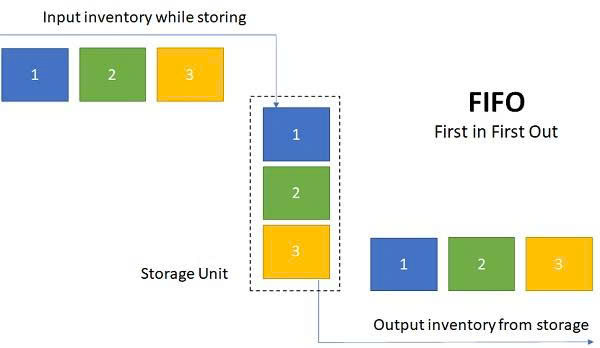
The philosophy of FIFO is straightforward: the oldest inventory acquired or manufactured is the first to be processed, sold, or shipped out.
Why It Matters
FIFO is the gold standard for any business handling products that degrade over time. It guarantees that inventory does not sit stagnant in dark warehouse corners, minimizing the risk of write-offs due to expiration or technological obsolescence.
Ideal Industries
- Fast-Moving Consumer Goods (FMCG) & Food & Beverage (F&B): Where expiration dates govern product viability.
- Pharmaceuticals & Cosmetics: Where batch control and strict shelf-life monitoring are legally mandated.
- Electronics & Semiconductors: Where rapid tech-cycles mean a microchip stored for too long faces market devaluation.
Physical Layout Requirements
FIFO demands a continuous, linear product flow. It relies on racking systems that offer separate entry and exit points for inventory. The most common configurations include:
- Pallet Flow Racks (Gravity Flow): Pallets are loaded from an upper inbound aisle and slide down a pitched wheel track via gravity toward the opposite picking aisle.
- Automated Radio Shuttle Systems: Remote-controlled shuttles move along internal rails to load and retrieve pallets sequentially, ensuring flawless batch rotation without forklifts needing to enter the rack structure.
2. Deep Dive into LIFO (Last In, First Out)
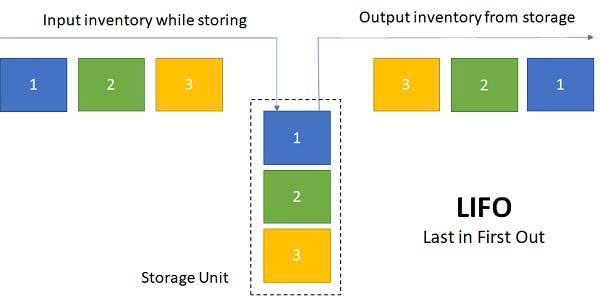
The philosophy of LIFO reverses the sequence: the newest inventory placed into the warehouse is the first to be retrieved and shipped out.
Why It Matters
While LIFO risks leaving older stock at the very back of a storage lane, it provides an incredible spatial advantage. Because goods are loaded and unloaded from the exact same side, it eliminates the need for multiple access aisles, drastically increasing a facility’s storage density.
Ideal Industries
- Bulk Raw Materials: Sand, gravel, coal, or cement, which do not degrade over time.
- Homogeneous Industrial Goods: Bricks, stone tiles, glass panels, or raw timber packs with near-infinite shelf lives.
Physical Layout Requirements
LIFO relies on single-entry racking architectures designed for high-density accumulation:
- Drive-In Racks: Forklifts drive directly into the racking lanes to deposit or retrieve pallets stacked multiple layers deep.
- Push-Back Racks: When a new pallet is loaded from the front aisle, it pushes the existing pallets back along nested carts riding on inclined rails. When the front pallet is removed, the remaining pallets roll forward to fill the gap.
3. Structural Comparison Matrix
Choosing between these two systems requires weighing density against selectivity:
| Technical Metric | FIFO (First In, First Out) | LIFO (Last In, First Out) |
| Racking Configuration | Double-sided access (Dedicated inbound/outbound lanes) | Single-sided access (Deep lane accumulation) |
| Space Utilization | Medium to High (Requires separate access aisles) | Ultra-High (Maximizes total cubic volume density) |
| Obsolescence Risk | Exceptionally Low | High (Back-row stock remains stagnant) |
| Handling Equipment | Continuous forklift flow, automated shuttles | Standard reach trucks, counterbalanced forklifts |
4. How Infrastructure Dictates Strategy Execution
Many supply chain operators select an inventory strategy on paper, only to find their physical building cannot support it. Executing high-density FIFO or LIFO models requires a warehouse engineered with specific physical capabilities:
- Uncompromising Floor Load Capacity: High-density LIFO drive-in racks or heavy-duty FIFO gravity flow systems create intense, localized weight concentrations. Standard warehouse floors can warp or crack under these conditions. Facilities require premium reinforced concrete slab floors to maintain structural stability.
- Maximum Clear Height Clearance: To maximize your vertical footprint and run 4-to-6 tier shuttle or push-back racks, excellent vertical clearance is mandatory to avoid overhead structural obstructions or fire sprinkler interference.
- Wide Column Spans: Large, uninterrupted bay spaces provide the physical flexibility needed to align and reconfigure complex racking systems without being structurally blocked by concrete columns.
5. KCN Vietnam: Infrastructure for High-Performance Warehousing
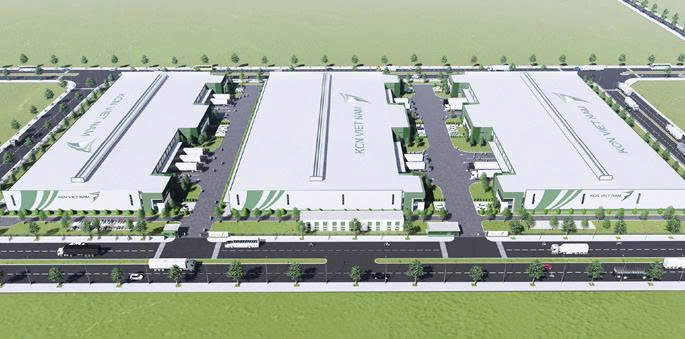
At KCN Vietnam, we engineer our industrial assets to ensure your inventory strategy is never limited by physical constraints. Our state-of-the-art Ready-Built Warehouses (RBW) across Vietnam’s primary industrial corridors (including Haiphong, Bac Ninh, Ho Chi Minh City, Dong Nai, and Long An) are built for modern logistics operations.
Our warehouses feature a floor load capacity of up to 3 tons/m² and excellent clear heights, providing the ideal structural foundation to support advanced racking systems.
Furthermore, because modern FIFO and LIFO tracking relies on flawless data execution, KCN Vietnam properties are equipped with robust power redundancies and high-speed fiber-optic networks. This advanced digital infrastructure ensures your Warehouse Management Systems (WMS), barcode scanners, and RFID tunnels remain continuously online, eliminating errors and maximizing supply chain velocity.
Conclusion
FIFO and LIFO are far more than simple financial or accounting choices – they are physical, spatial strategies that dictate how your warehouse operates. By aligning your business goals with the right inventory model and choosing a technically superior facility like those offered by KCN Vietnam, you optimize your operational footprint, cut overhead costs, and future-proof your supply chain.
KCN MANAGEMENT AND SERVICES JSC
HEADQUARTER
Level 10 – Saigon View,
117 Nguyen Cuu Van, Gia Dinh Ward,
Ho Chi Minh City, Vietnam
HANOI OFFICE
Suite 1812 – Charmvit Tower,
117 Tran Duy Hung, Yen Hoa Ward,
Hanoi, Vietnam
Hotline: 1900 0089
Tel: +84 28 7777 0089